MONETARY PROGRAMMING FOR THE FOURTH QUARTER OF 1999
A. The economy in the 3rd quarter of 1999
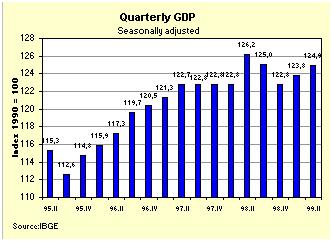
1. Based on data drawn from the series released by the Brazilian Institute of Geography and Statistics (IBGE) and purged of seasonal factors, gross domestic product (GDP) expanded by 0.93% in the second quarter of 1999. Growth in the period between April and June was generated by the following results under industry, services and crop and livestock farming: 2.04%, 0.05% and -0.79%, respectively. Despite the 0.42% decline in GDP in the first half of the year, when compared to the same period of the previous year, this result was not as bleak as the very somber forecasts made at the start of the year. In this context, the increase in the level of confidence in the Brazilian economy reflected both the highly favorable trajectory of inflation in the period of rapidly changing expectations that coincided with the transition to the new system of exchange, as well as continued application of an austere fiscal policy.
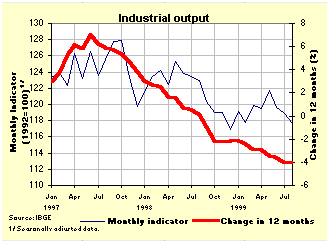
2. In the first two quarters of 1999, IBGE statistics from which seasonal factors have been removed by Banco Central indicate that industrial output expanded by 0.5% and 1.2%, when compared to the identical preceding periods. However, in the half-year period, industrial production registered a decline of 3.2%, reflecting reductions of 5% under consumer goods, 12.7% under capital goods and 0.66% under intermediate goods. In the month of August, industrial output dropped by 1.08%, as against contraction of 0.58% in the previous month. Accumulated 12 month negative growth came to 3.86%. The mineral extraction industry turned in expansion of 13.8% in the 12 month period up to July, thus continuing an ongoing and steady growth trajectory in this sector. In contrast to this performance, manufacturing closed with a 5.2% drop, continuing a trend that first became evident in October 1997.
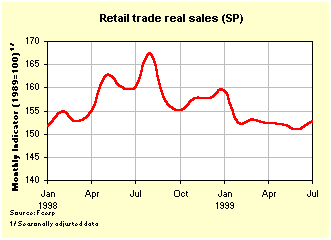
3. Figures released by the Trade Federation of the State of São Paulo (Fcesp) for the metropolitan region of São Paulo based on data from which Banco Central has removed seasonal factors indicate that real billings in the retail trade sector increased by 1.1% in July, when compared to the previous month. This result reflects growth of 3.6% in the segment of consumer durables and a cutback of 4.7% under automotive sales, partly as a consequence of a 3.5% drop in the sales of factory authorized vehicle outlets. The real billings of the retail trade sector in the metropolitan region of São Paulo diminished by 2.5% in the year up to July, when compared to the same 1998 period. When sales through factory authorized outlets are excluded, this result turns positive (5.3%). In the same period, the metropolitan regions of Belo Horizonte and Rio de Janeiro registered respective accumulated declines in billings equivalent to 12.6% and 4.6%.
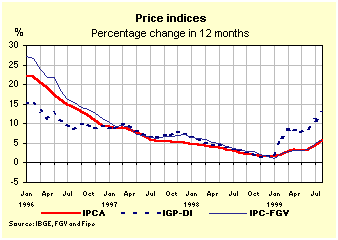
4. Starting in April, inflation turned downward as the effects of the January exchange devaluation were dissipated. However, with the sharp increases registered in June and August under government administered prices, farm products and medicines, the downward trajectory was reversed. The most intense and immediate impacts occurred under general price indices, reflecting price highs in the wholesale sector that were later felt with less intensity and considerable lag under consumer price indices. In 12 month accumulated terms up to August, the General Price Index - Market (IGP-M) and General Price Index - Domestic Supply (IGP-DI) expanded by 11.81% and 12.64%, respectively, while the Consumer Price Index - (IPC - Fipe) and National Consumer Price Index (INPC) registered positive growth of 3.14% and 5.25%. IBGE's Broad Consumer Price Index (IPCA), which is used as the inflation target, registered growth of 1.09% in July, raising accumulated growth to 4.57% over 12 months.
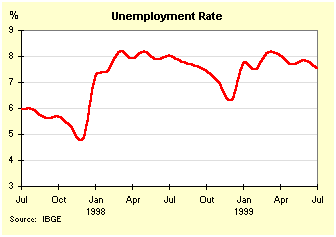
5. As measured by IBGE, basic unemployment came to 7.54% in July, or 3.83% less than in the previous month. An analysis on the basis of 12 month growth shows that the unemployment level dropped by 6%, particularly as a consequence of a 6.39% reduction in the non-working population. In the period, the economically active population declined by 0.16%, while the working population increased by 0.38%. One should note that the growth trajectory under informal labor continued, as evinced by the fact that the number of nonregistered workers increased by 3.8% while those with registered working papers dropped by 2.7%.
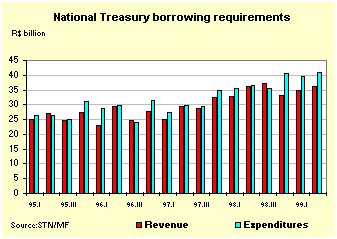
6. In the first half of the year, the central government registered a primary surplus of R$ 12.3 billion. This result is equivalent to 2.6% of GDP as compared to 0.4% in the same period of the previous year. In nominal terms, revenues expanded by 12.9% and closed at R$ 99.9 billion, while expenditures registered growth of 1.25%, closing at R$ 87.3 billion. National Treasury accounts closed with a surplus of R$ 16.3 billion. The factors responsible for this result were reductions under current expenditure and capital outlays (12.5%) and personnel and charges expenditures (4.1%); growth under tax inflows (Cofins, income tax and IOF); and anticipated payment of Telebrás system privatization installments. In the month of July, the central government registered a primary surplus of R$ 1.9 billion, as compared to a deficit of R$ 104 million in the corresponding period of the preceding year. This is clear evidence of the government's continued commitment to the adjustment of public sector accounts.
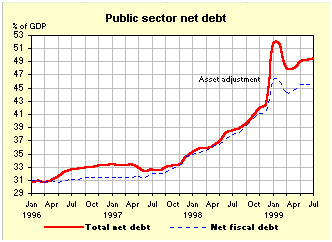
7. The Net Public Sector Debt (DLSP) totaled R$ 495.3 billion in July, corresponding to 49.5% of GDP. This result was R$ 3.8 billion below the indicative target stated for the month in the agreement with the International Monetary Fund (IMF). In relation to the December 1998 debt stock, DLSP growth reflected changes in exchange rates for the most part. The net internal debt came to R$ 389.9 billion while the net foreign debt closed at R$ 105.4 billion.
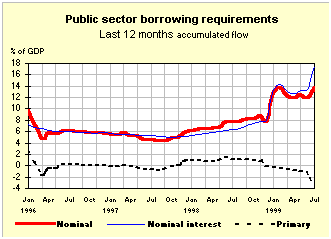
8. In the primary concept, public sector borrowing requirements registered a surplus of 3.6% of GDP in the first seven months of the year. The final result (R$ 20.4 billion) was R$ 4.8 billion beyond the performance criterion defined in the agreement with the IMF. In the nominal concept, NFSP reached a level of 13.8% of GDP in the first six months of the year, as compared to 7.0% of GDP in the same period of the previous year. This increase reflects the impact of the exchange devaluation on nominal interest outlays, which increased from 7.3% of GDP between January and July 1998 to 17.4% of GDP in the same 1999 period. Utilizing the same basis of comparison, an analysis of NFSP from which the effects of the exchange devaluation have been eliminated points to a level of 6.1% of GDP in comparison to 6.7% in 1998, while nominal interest came to 9.7% of GDP as against 7.0% in the previous year.
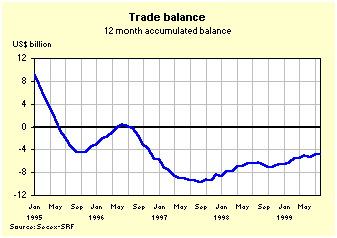
9. In the July/August period, the balance of trade registered relative equilibrium with exports of US$ 8.1 billion and imports of US$ 8.2 billion. Foreign sales have continued the process of recovery begun in May. Expansion has been concentrated mostly under volume, particularly in the case of manufactured goods, at a time in which the prices of the major farm commodities were depressed. Imports continued expanding gradually, mostly as a result of international oil price increases. Between January and August, the balance of trade registered a negative result of US$ 706 million, compared to a deficit of US$ 2.5 billion in the same period of the previous year. In the period under consideration, export operations added up to US$ 30.8 billion or 11.7% less than in the same period of the previous year, while imports declined by 15.5% and closed at US$ 31.5 billion.
10. The balance of payments in current account closed the July/August period with a negative result of US$ 3.4 billion, raising the accumulated deficit for the year to US$ 15.6 billion, as against a deficit of US$ 17.1 billion in the same period of 1998. Among the factors that contributed to the reduction in the period under consideration, one should cite declining imports and reduced demand for nonfactor services, particularly international travel, a segment of activity that showed itself to be highly sensitive to the exchange devaluation that occurred at the start of 1999. The deficit in the service account came to US$ 16.3 billion, compared to US$ 15.9 billion in the same period of the previous year. This was a result of growth in outlays on interest to US$ 9.3 billion (+45%).
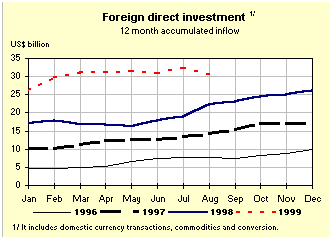
11. In accumulated terms for the year up to August, net inflows of direct foreign investments totaled US$ 20 billion and have expanded at a particularly strong pace, even when one excludes inflows consequent upon privatizations and conversions of liabilities. In this sense, net inflows of direct foreign investments plus long-term loans, which totaled US$ 14.4 billion, accounted for 67% of external borrowing requirements in the period, thus attenuating the pressures generated by amortization flows (US$ 35.7 billion) on the international reserve position.
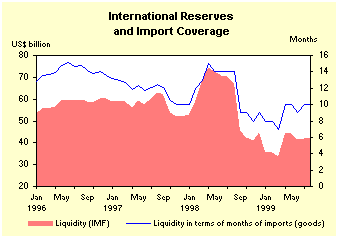
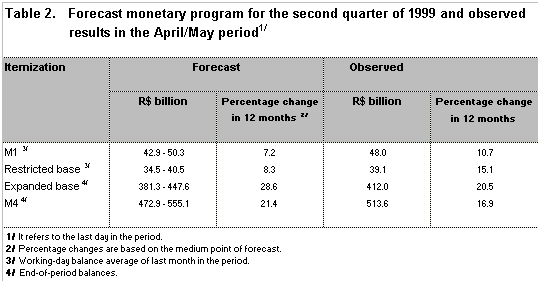
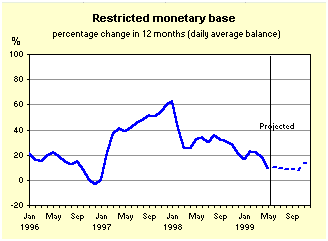
12. Changes in the international reserve stock have almost exclusively reflected Banco Central foreign operations. In the month of August, international reserves came US$ 41,9 billion, in the international liquidity concept, corresponding to approximately 10 months of imports of goods.
B. Monetary policy in the 2nd quarter of 1999
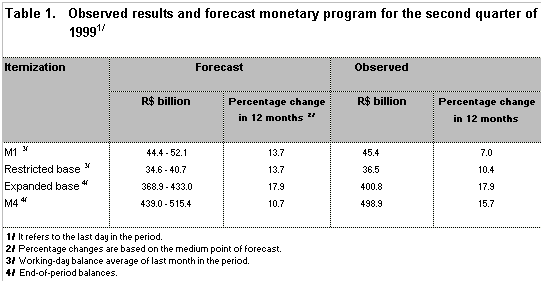
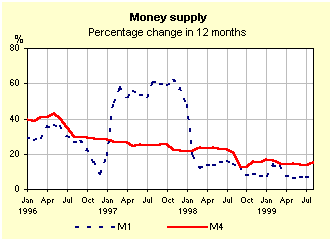
13. In June, the restricted monetary base came to US$ 36.5 billion, based on the concept of average daily balances. This result was well within the parameters defined in monetary programming for the second quarter of the year. In the month, the monetary base increased by 2.9% and raised accumulated 12 month growth to 10.4%. Currency issued turned in expansion of 2.1% in the month of June, with 14.7% growth over 12 months, and closed with a volume of R$ 20.5 billion, while banking reserves (R$ 16 billion) expanded by 4% and 5.3%, utilizing the same basis of comparison.
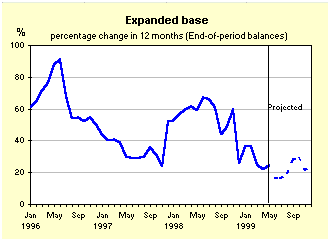
14. The broad monetary base, which encompasses the restricted base, compulsory cash deposits and federal securities outside Banco Central, totaled R$ 400.8 billion in June, well within the parameters defined by monetary programming for the second quarter of 1999. In the month, this aggregate registered 1.1% growth based on an increase of 4% in the balance of federal public securities outside the Banco Central portfolio. In twelve months, the broad monetary base expanded by 17.9%.
15. Based on the concept of average daily balances, the money supply (M1) totaled R$ 45.4 billion in June with positive growth of 2.6% in the month and 7% in twelve months. These figures were also within the upper and lower limits set by monetary programming. Currency held by the public and demand deposits came to respective totals of R$ 17.9 billion and R$ 27.5 billion, for growth of 2.5% and 2.6% in the month, in the same order. In accumulated twelve month terms, growth came to respective levels of 14.8% and 2.4%.
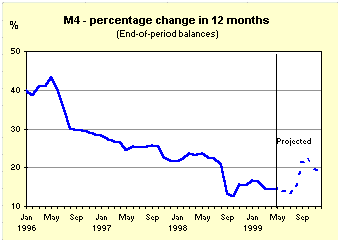
16. In the month of June, the broader monetary aggregate (M4) came to R$ 498.9 billion, also with the upper and lower limits defined in monetary programming. Growth in the month came to 2.7% and was partly caused by an increase in the stock of federal public securities held by the nonfinancial public. In twelve month terms, growth of this aggregate closed at 15.7%.
17. Operations with federal public securities turned in growth of R$ 266 million in the second quarter of the year. In the case of the primary market, net placements generated monetary contraction of R$ 6 billion, based on redemptions of Banco Central papers totaling R$ 27.2 billion and placements of R$ 33.2 billion in National Treasury papers. In the secondary market, security operations generated an expansionary impact, with net purchases of R$ 7 billion, while the extramarket segment registered sales of R$ 266 million.
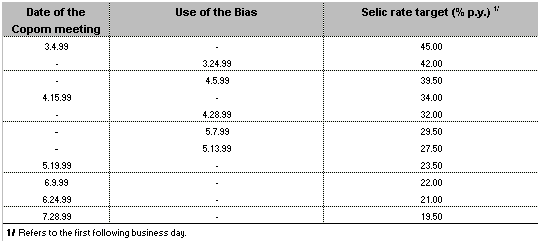
18. With the increasingly favorable macroeconomic scenario that started to take shape in March, the Banco Central Monetary Policy Committee (Copom) lessened the restrictive nature of monetary policy in the second quarter of the year. The target for the Selic rate was cut from 39.5% per year on April 5 to 21% per year on June 23.
19. Circular no. 2,900, dated June 29, 1999, determined the current regulations governing the Monetary Policy Committee. This document defined the operational framework of the Committee in terms of the system of inflation targeting, adopted through Decree no. 3,088, dated June 21, 1999. The Circular in question made it absolutely clear that the primary end of monetary policy is meeting the inflation target. According to current regulations, the Committee is charged not only with defining monetary policy guidelines and specifying the Selic rate target and possible biases, but also with analyzing the macroeconomic scenario and the major risks associated with it and evaluating the Inflation Report, which is the foundation upon which monetary policy will be implemented.
20. On May 6, Banco Central issued Circular no. 2,885, reducing the reserve requirement rate on time resources from 30% to 25%. This measure had an expansionary impact on financial system liquidity and, consequently, is expected to contribute to increased credit availability and a reduction in the differential between the asset and liability rates of the banking system.
C. Monetary policy in July/August 1999
21. In the month of August, the restricted monetary base came to R$ 39.1 billion, based on the concept of average daily balances. This figure represented stability in the month in question and growth of 15.1% in the last 12 months. Currency issued and banking reserves closed with respective levels of R$ 21 billion and R$ 18 billion, for growth rates of -0.7% and 0.9%. In the last 12 months, growth came to 14.5% and 15.7%, in the same order.
22. The expanded monetary base closed the month at R$ 412 billion. Growth in the month came to 1.2%, with 20.5% expansion in the last 12 months.
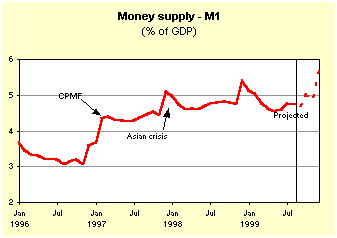
23. Analyzed in terms of average daily balances, the money supply (M1) totaled R$ 48 billion in August, for growth of 0.5% in the month and 10.7% in the past 12 months. Currency held by the public and demand deposits closed with respective levels of R$ 18.3 billion and R$ 29.7 billion. The balance of currency held by the public declined by 0.6% in the month, while demand deposits increased by 1.2%. With these results, the last 12 months closed at respective levels of 14.6% and 8.4%. Growth under this aggregate was a direct result of the impact of reintroduction of the Provisional Contribution on Financial Transactions (CPMF) on currency demand and, more specifically, on the balance of demand deposits. Twelve month growth under this heading rose from 2.4% in June to 8.1% in July.
24. The balance of the broader monetary aggregate (M4) totaled R$ 513.6 billion at the end of August, for growth of 2% in the month and 16.9% in the last 12 months.
25. Operations with federal public securities generated an expansionary impact of R$ 5.3 billion in the July/August period. Net redemptions in the primary market resulted in monetary growth of R$ 11.9 billion, based on redemptions of R$ 9 billion in Banco Central papers and R$ 2.9 billion in National Treasury securities. In the secondary market, security operations generated a contractive impact, with net sales of R$ 6.5 billion, while the extramarket sector closed with sales of R$ 112 million.
26. In the July/August period, Copom maintained the downward interest rate trajectory, as indicated in the table below:
Evolution of Selic rate target
27. Issued on July 7, Banco Central Circular no. 2,908 reduced the reserve requirement rate on time resources from 25% to 20% in order to expand monetary liquidity and begin closing the gap between the inflow and investment rates practiced by financial institutions.
D. Outlook for the 4th quarter of 1999
28. A deeper analysis of the major macroeconomic indicators demonstrates that the activity level has intensified, albeit at a very moderate pace. However, when one compares the second and first quarters of the year, the level was still below the 1998 figure. To some extent, performance in the first half of 1999 was somewhat surprising, particularly after the very somber predictions that had marked the early months of the year. At the same time, this is a result of improved expectations among economic agents once the initial impact of the exchange rate shift had been dissipated and basic interest rates turned downward. Notwithstanding the fact that the recovery process is expected to cool somewhat in the third quarter of the year, growth in the gross domestic product will be satisfactory.
29. In this context, one should stress the fact that reserve requirements on time deposits and demand deposits were reduced, thus preparing the way for a cutback in the differential between the asset and liability rates of the banking system and, consequently, for a larger volume of credit. Having achieved this, it is hoped that economic growth will be powered by private spending in a scenario in which the level of utilization of installed industrial capacity will remain within comfortable parameters.
30. Once again, the government's efforts to foster an effective public accounts adjustment are evident. In more specific terms, the fiscal result of the first half of 1999 easily surpassed the performance criterion negotiated with the IMF, At the same time, the annual budget for next year, which was sent to the National Congress on August 31, makes it patently clear that the fiscal adjustment process will continue into the future.
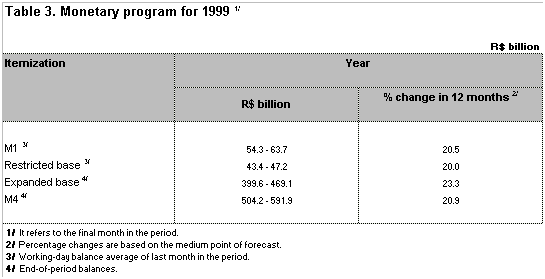
31. With respect to trade relations with the international community, growth in Brazilian exports depends on upturns in both world demand, particularly among Latin American countries, the largest importers of Brazilian manufactured goods, and in international farm commodity prices. A drop in import operations tends to reflect the evolution of prices and income and, over the medium-term, will certainly be impacted by the increased pace of the domestic economy.
32. Foreign payments requirements remain high, though they have begun moving downward. What is important is that it has been possible to finance these resources without generating undesirable impacts on the international reserve level. Here, one should underline the fact that changes in the reserve position are almost exclusively due to Banco Central external operations. The substantial inflow of direct foreign investments bears witness to renewed international financial community confidence in the fundamentals of the Brazilian economy.
33. In this scenario, price indices are not expected to undergo any truly significant pressures in coming months for several reasons. In the first place, an analysis of the factors that determine internal demand, such as income, do not point to strong growth in consumption. Secondly, with regard to supply, the level of industrial capacity utilization coupled with growth in productivity rates, compared to the unit cost of labor, also indicates an absence of inflationary tensions.
34. Average inflation in coming months is expected to vary in a range close to 0.5% per month. The major sources of upward pressure will be expectations of farm price highs in the period between harvests and a seasonal high in apparel prices toward the end of the year. At the end of 1999, accumulated inflation is expected to close at about 15% in the general indices and between 6.5% and 8% for consumer price indices.
E. Indicative monetary aggregate growth targets for the 4th quarter of 1999
35. Programming for the monetary aggregates in the final quarter of 1999 was based on the probable scenarios for inflation, GDP and interest rates, together with the monetary impacts generated by National Treasury operations, Banco Central interventions in the financial system and open market and exchange system.
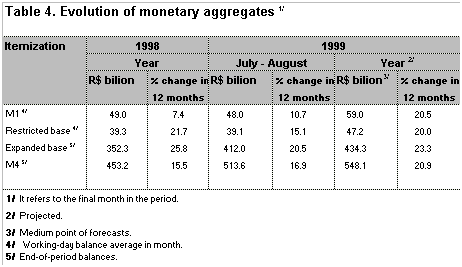
36. Money supply projections (currency held by the public plus demand deposits) are consistent with inflation targets and with the scenarios adopted by Banco Central for internal interest rates and income growth in the coming months. Other factors capable of exerting pressure on this aggregate have also been considered, such as possible monetization caused by end-of-year difficulties in bank computer systems. Twelve month growth in average daily money supply balances was estimated at 20.5% in December 1999.
37. Upward movement in the M1/GDP ratio since implementation of the Real Plan can be ascribed to monetization of financial assets in the wake of the stabilization program and to the impacts of taxation on financial transactions. In the latter case, the result was a reduction in the circulation velocity of the money supply, thus provoking a rise in the stock required for the same volumes of transactions. It should be noted that, among money supply components, currency adjusts more slowly to changes in the economic environment and is responsible for the gradualism of the monetization processes that occurred.
38. Based on the forecast performance of currency demand and the expected banking reserve scenario, 12 month growth in the average monetary base balance (currency issued plus banking reserves) is projected at 20% in December 1999.
39. The projection for the broad base (a measure of the federal monetary and securities debt) presupposes neutralization of the undesirable impacts of the factors that condition the restricted base. With this, it concluded that the major expansionary factor in coming months - updating of the federal security debt - will, to some extent, be offset by primary National Treasury results. Thus, the twelve month projection for growth under this monetary aggregate is projected at 23.3% in December 1999.
40. In much the same way, M4 growth over 12 months was estimated at 20.9% in December 1999, a level considered consistent with the performance pattern of the other aggregates and with the growth in short-term investment funds since August.
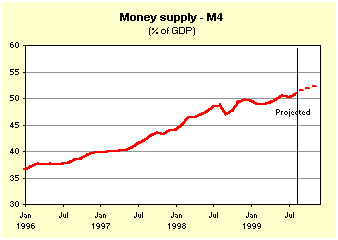
41. The ratio between M4 and GDP is expected to expand in the remaining months of the year, principally as a result of growth in interest rate levels and GDP performance in the period.
42. Evolution of the monetary aggregates is summarized in the following chart, which presents the final 1998 figures, together with the July/August 1999 results and projections for the current year as a whole.
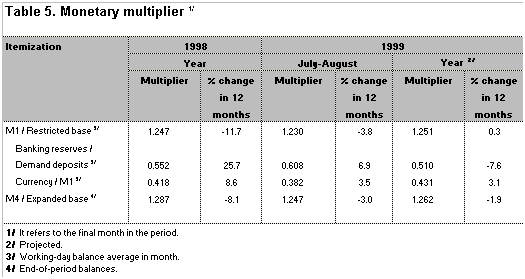
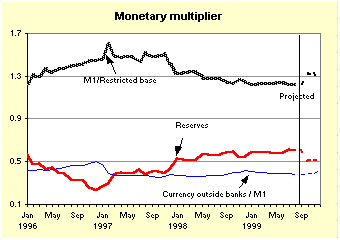
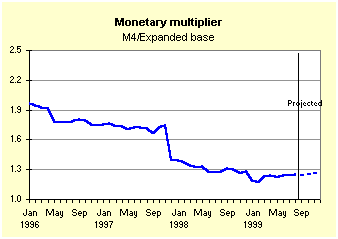
43. The following chart summarizes the evolution of different multipliers implicit in monetary programming.
44. With the reduction in the reserve requirement rate on time deposits, the money supply multiplier is expected to move upward.
45. The expanded base multiplier is expected to remain at relatively stable levels in coming months, since there is no real expectation of more intensive activity on the private securities market.